When the frost bites on a Levi ice fishing day
Lapland cold is part of the deal on any ice fishing trip from Levi, and most days are fine in good clothing. A few deep-cold days each winter call for more care, especially on a snowmobile. This guide covers how the tours handle them, what your own options are, and the signs that it is time to warm up.
How cold Levi gets in the ice season
Levi winters are long and dry, with daytime readings of −10 to −25 °C (14 to −13 °F) quite normal. Deep midwinter can bring −30 °C (−22 °F) or lower, usually under a clear, still sky.
Those deep-cold days often look lovely, with frost on every branch under a pale light. The cold itself is dry, which feels kinder than a damp −5 °C (23 °F) at home, until the wind starts.
Around midwinter Levi also has polar night, a few weeks when the sun stays below the horizon. The cold and the short light arrive together, which our guide to the best time to book weighs up.
Do the tours go out in deep cold?
None of the five listings names a temperature at which the trip is called off. The trips are built for Lapland winters, and the call on an extreme day rests with the operator and the guide.
If an operator changes or cancels a trip, the terms on its listing apply, so read them before you pay. Do not plan around a figure from a forum, since none of these listings gives one.
Your own side is simpler. GetYourGuide and Viator both show free cancellation up to 24 hours before the start on all five tours, so you can watch the forecast and decide the day before.
Cancelling yourself makes most sense when someone in your group is already unwell or hates the cold. Everyone else usually does fine with good layers and a trip with a fire or a heated shelter, which turn a hard frost into a bright, clear day on the lake.
Wind chill on the snowmobile trips
Still air at −20 °C (−4 °F) is bearable in good clothes. Moving air is a different matter, and on a snowmobile ride to the lake you make your own wind for the whole crossing.
That applies to Safartica's snowmobile safari with lunch (~$234) and to Arctic Circle Snowmobile Park's ice fishing by snowmobile (~$190). Both lend winter clothing, and the second adds a helmet and a balaclava.
How fast the group rides depends on the weather and the drivers, according to Safartica's listing. Slower riding on a bitter day means less wind on your face, though a longer time out in the cold.
Passengers feel it more than drivers, who at least move their arms and steer. Sit low behind the driver with your face covered. Swap places when you take turns so nobody stays in the wind for the whole ride.
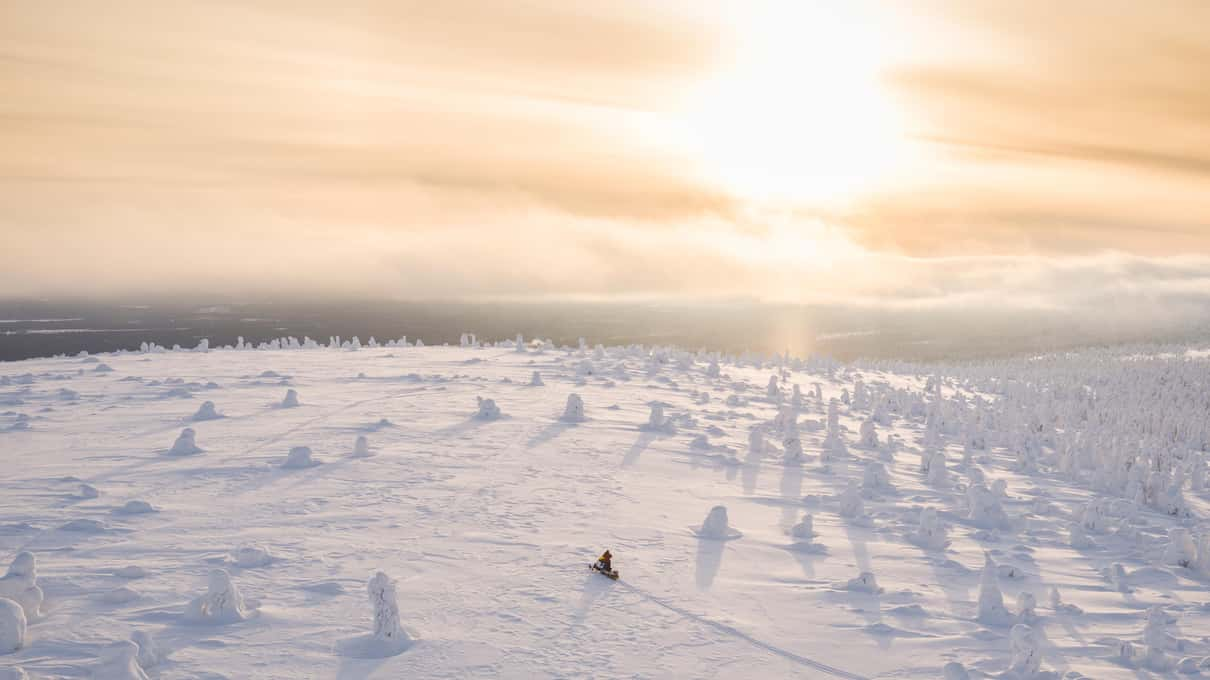
Heading out by sled on a clear, frosty day?
Arctic Circle Snowmobile Park lends an overall with boots and gloves plus a helmet and balaclava, then leads the group through the forest to a lake that only sleds can reach.
Warm-up breaks on the ice
Trips with a fire or a heated room make deep cold far easier. Keo Wilderness (~$99) has a heated wooden shelter and an outdoor fireplace, and its hot salmon soup does the rest.
On Safartica's trip by car (~$122) the warm car takes you to the lake and back. Beyond Arctic (~$117) lights a campfire and serves hot drinks with snacks.
Take those breaks before you need them. Ten minutes by the fire while your fingers still work keeps the trip pleasant, and no tour can promise a catch whatever the temperature.
Frostbite signs to watch for
Frostbite usually starts on the face (nose and cheeks first) or on the ears and fingertips. The skin turns pale or greyish-white and feels numb or waxy, often without pain, so check each other's faces every so often.
Cover any pale patch you spot and warm it gently with a warm hand or by the fire. Never rub it with snow or a glove, and tell the guide straight away.
Numb toes are the other early warning. Wriggle them often, walk a few steps around the hole, and speak up if they lose feeling, since any guide would rather hear it early.
Dressing for the deepest cold
Below about −25 °C (−13 °F) the layering rules tighten. Wool goes next to the skin and a warm mid-layer over it, with the operator's overall on top and no cotton anywhere.
Cover every bit of skin you can, and pack spare gloves plus hand warmers. Our guide to dressing for the ice goes through each layer from socks to beanie.
Phone batteries can shut down quickly at these temperatures. Keep the phone inside your jacket and plan on a few photos rather than a long video.
Leave yourself a spare day
The safest plan is to book the fishing early in your stay. If the forecast looks grim or the operator changes the trip, you still have days left to move it.
A short trip of 2.5–3.5 hours suits the coldest days, and the five-hour safari suits milder ones. Our two-day plan for Levi pairs a short and a long trip with room to swap them around.
Children feel the cold faster than adults, so these rules matter twice as much with a family. The guide to ice fishing with children covers which tours keep them closest to a fire.